
Use the method
Start with something real. Look closely, explore all four lenses, and turn what you notice into a useful next move.
Your first ACID analysis
Set the context
Choose the work you want to understand. Name its audience and purpose. For a company, look at its services, communication, and representative work so the picture reaches beyond the homepage.
Look through every lens
Ask what it means (A), what it expresses or transforms (C), how it works toward its purpose (I), and how it connects with human experience (D). Examine each one, even when another feels dominant.
Show what supports your reading
Point to a phrase, a visual choice, a structural detail, or a moment in an experience. Connect that observation to your interpretation and explain why it matters for this audience.
Map the emphasis
Place your reading over the original framework as a heat map. Identify the dominant areas and the relationships between them. Keep missing evidence separate from a quality that is genuinely less prominent.
Choose a next move
Preserve what works. Name the most useful change and decide how to check it, through a conversation, a prototype, a usability check, or audience feedback.
Read the heat map
A heat map makes the relative emphasis of your interpretation visible. Red marks the most prominent areas. It fades through yellow, green, and blue toward less prominent areas.
“Turn a memory into a poster. A free workshop for first-time makers, with guidance throughout. Bring one photo and book your place.”
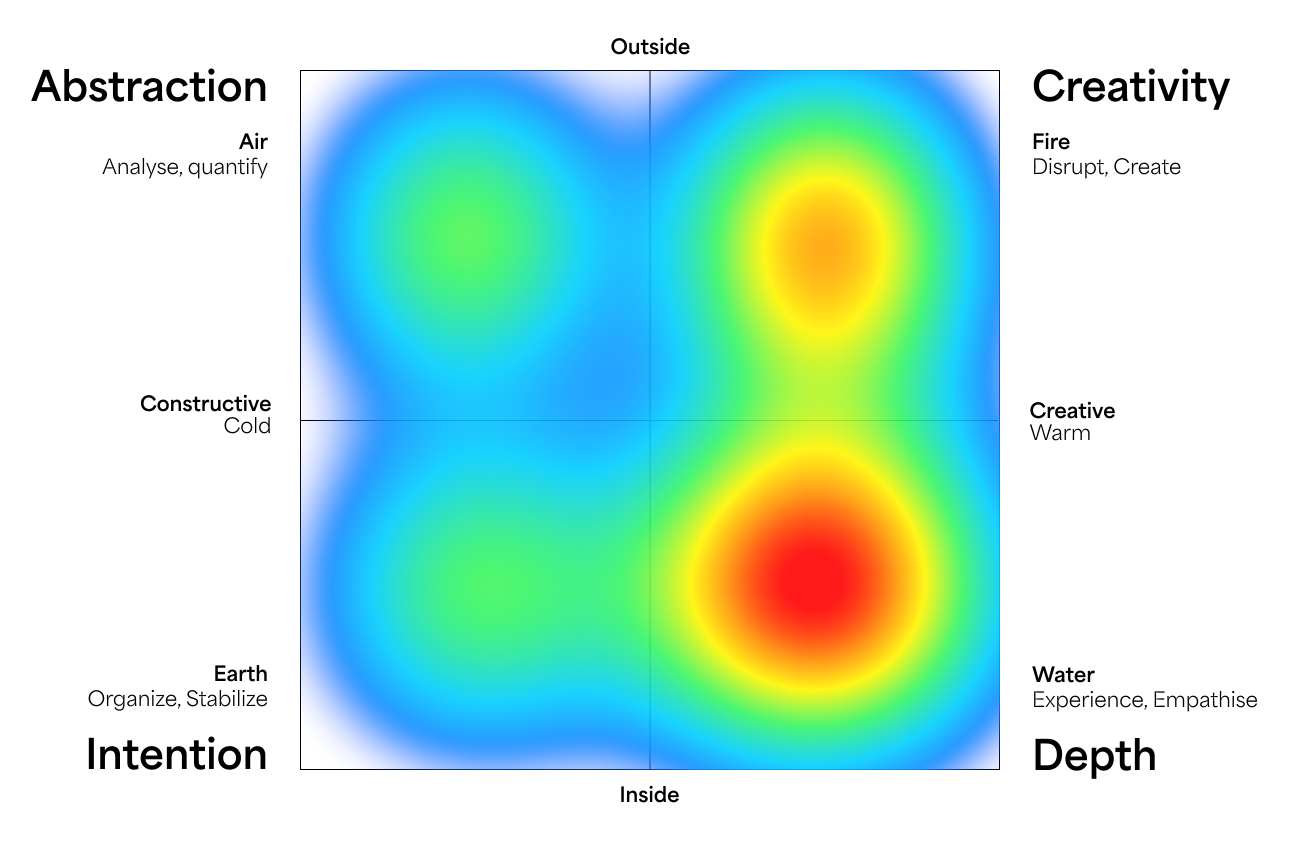
A hot area means a quality is prominent. It does not automatically mean the work is good. A cool area can be appropriate for the purpose, and an unknown area needs to be labelled as such.
Keep the map honestThe original framework provides no numerical scale, fixed weighting, or ideal profile. The heat map is a qualitative adaptation. Support each conclusion with something you can actually observe.
Use ACID with AI
The free ACID Method skill gives an AI assistant the framework, the original diagram, and a workflow for analysing all four lenses. It includes instructions for the heat-map visual.
Get the skill and installation guide
Once it is installed, share the material and ask for an ACID analysis. You can use this prompt as a starting point:
Use the ACID Method by Design On Acid to analyse the material I share next.

Ask who it is for and what it needs to achieve. Assess Abstraction, Creativity, Intention, and Depth, grounding each finding in the work.

Show the dominant areas as a continuous heat map over the original ACID framework. Explain how the lenses work together, then suggest the most useful next changes and how to check them.
Using another AI assistant?The repository also includes a portable prompt. Share it together with the original framework SVG. The assistant needs access to your material and a way to render the visual.
Take it further
Use the same audience, purpose, and criteria to compare two directions. Revisit the map after a change and discuss what moved. Invite someone else to explain their reading and compare the evidence behind it.
For a personal reflection, discover your ACID strengths through approved conversation history or a 21-question interview.
The useful outcome is a clearer decision about the work. Keep the conversation open, and let what you learn shape the next iteration.
The framework and skill are available under CC BY 4.0. Credit Design On Acid and indicate adaptations when you share your own version.