

Fire
Ignis
Hot + dry
Four roots. Two forces. A world in constant recombination.
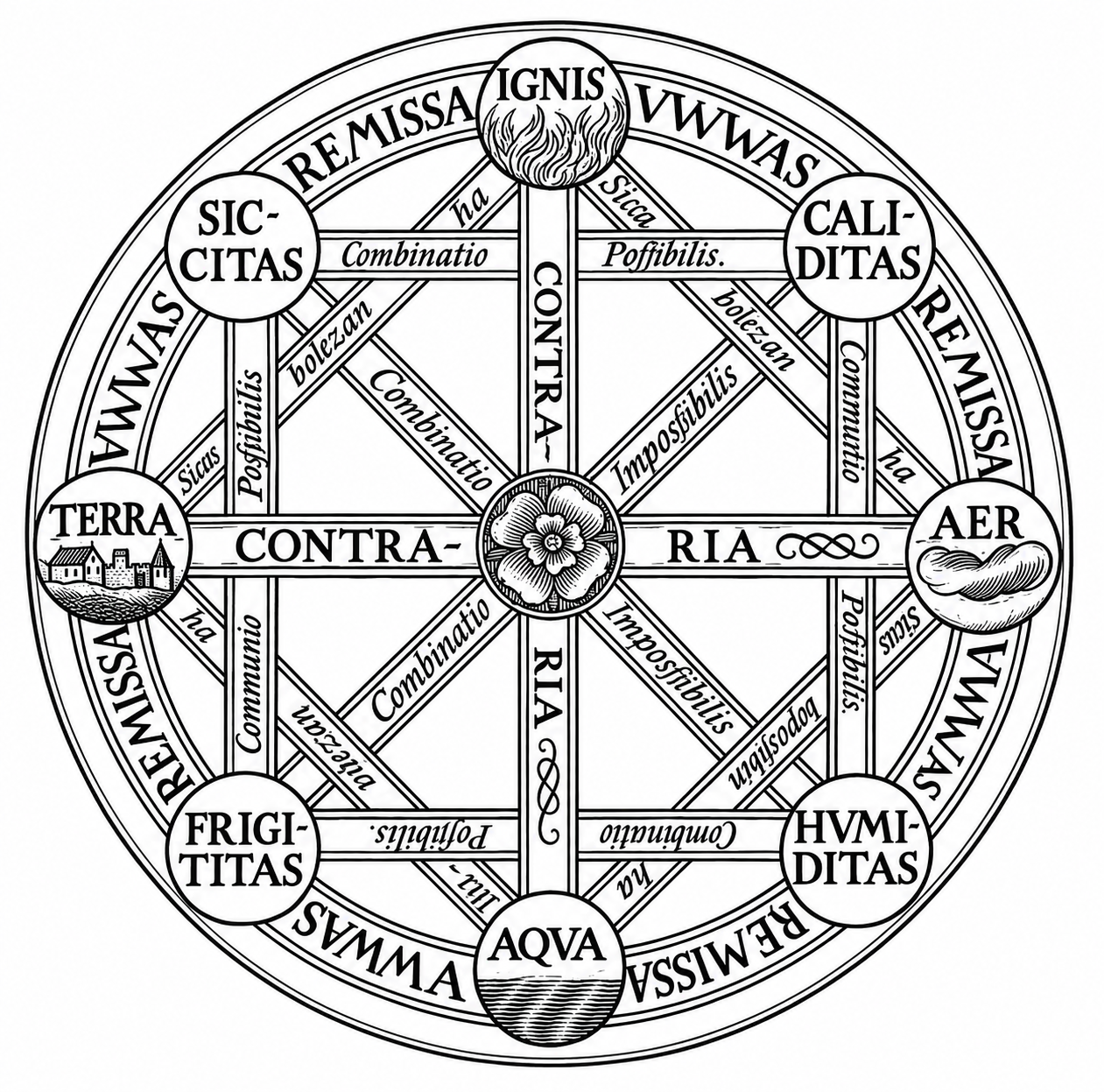
Empedocles was a Greek philosopher from Acragas, in present-day Sicily, active in the fifth century BCE. He described nature in verse, proposing four enduring “roots”: earth, water, air, and fire.
In his model, things emerge as the roots mix in different proportions and disappear as those mixtures separate. The roots themselves persist. Change is a rearrangement of what already exists.
Two forces drive this movement. Love brings different roots together; Strife separates them. Their alternating influence makes the cosmos a cycle of union and division.
His model describes relationships as well as ingredients: the same roots can form very different things through the ways they combine.
Read more in the Stanford Encyclopedia of PhilosophyLater, Aristotle developed a scheme of paired qualities: hot and cold, moist and dry. Each element takes one quality from each pair. The wheel places shared qualities between neighbouring elements and opposing elements across its centre.
Ignis
Hot + dry
Aer
Hot + moist
Aqua
Cold + moist
Terra
Cold + dry
Latin key: caliditas = heat; frigiditas = cold; humiditas = moisture; siccitas = dryness.
Aristotle, On Generation and Corruption, Book II, parts 2–3The ACID Method uses the elements as creative archetypes. This is our contemporary interpretation of the elemental tradition: a way to move between thinking, making, structuring, and feeling.
The impulse to transform. Experiment, challenge conventions, and give ideas a visible form.
The space to think. Observe patterns, question assumptions, and find the idea behind the expression.
The capacity to connect. Explore feeling, meaning, and the human experience of a brand.
The structure that holds. Make deliberate choices and build a coherent system that can endure.
A brand needs room for all four. The value of this lens lies in asking how they work together, and which perspective a project needs next.
Back to the ACID Method

