
Discover your strengths
How do you make sense of things, create, take action, and connect? Use ACID to explore the tendencies that feel natural to you and the strengths you can build on.
Two ways to get to know yourself
The ACID Method by Design On Acid can also guide personal reflection. Work with an AI assistant to explore real examples from your life, then bring the patterns together in a strengths profile and a map across Abstraction, Creativity, Intention, and Depth.
Reflect on conversations you choose to share. Look for recurring preferences, decisions, and ways of working.
Answer 21 questionsStart fresh with a guided interview. Share examples at your own pace, one question at a time.
A starting point for self-understandingThis is an LLM-assisted adaptation of ACID for reflection. It is not a validated personality test or diagnosis. Your profile is a contextual interpretation you can question and revise.
First, install the free ACID skill or use its portable prompt. For the portable version, also share the original framework SVG. Your assistant needs a way to render the heat map. Run either route in your chosen assistant; this page does not access your conversations or collect interview answers.
Use conversation history you approve
Choose what to share
Use this conversation, selected conversations, or pasted excerpts. Name any topics or dates you want excluded. Choose material that reflects your own decisions and experiences.
Give approval for that scope
The assistant should only review the material you explicitly approve and it can actually access. Approval cannot give it access to unavailable chats. If needed, supply selected excerpts or choose the interview.
Look for patterns and exceptions
Ask it to connect its reading to your examples, distinguish natural preferences from work demands, and acknowledge gaps. A sample about work may reveal your working style while leaving other parts of life unexplored.
Use the ACID Method by Design On Acid to explore my strengths and recurring traits.

I approve using only my own messages in this conversation. Ask before using any other history. Tell me what you can actually review; if it is unavailable or too limited, offer selected excerpts or the 21-question interview.

Assess Abstraction, Creativity, Intention, and Depth. Connect each finding to examples, distinguish natural preferences from circumstances, and consider counterexamples. Allow multiple dominant areas or no clear dominance. Keep missing evidence separate from weakness.

Give me a practical strengths profile and a qualitative heat map over the original ACID framework. Suggest a few small experiments and invite me to correct your interpretation.
Edit the scope in the prompt before sending if you want to use different material. You can withdraw approval or switch to the interview at any point. That stops further use in this exercise; it does not delete history stored by your assistant.
Discover your tendencies in 21 questions
The interview covers understanding, expression, action, connection, and how these come together in your life. There are no preferred answers. Describe what you actually do, what gives you energy, and what your circumstances require of you.
Ask one question at a time, or choose small batches. Short answers are welcome, concrete examples help, and you can skip a question or stop. A profile based on fewer answers should clearly show its limits.
Use the ACID Method by Design On Acid to help me discover my strengths and recurring traits through the skill's 21-question interview.

Ask one question at a time and show my progress. Use only my interview answers for this exercise. Let me skip questions, and wait until the interview is complete before creating my profile unless I ask for a partial view.

Then assess all four ACID lenses with examples from my answers. Explain my strongest supported tendencies, possible tradeoffs, and the conditions that help my strengths. Include a qualitative heat map over the original framework, practical experiments, and an invitation to correct the reading.
Explore the questions
You can also reflect on these yourself or bring your answers to the assistant. Each section opens to show the questions.
Understanding and patterns1–5
- When you encounter something unfamiliar, what do you naturally do first? Describe a recent example.
- Tell me about a time you made a confusing situation clearer. What did you notice, and what did you do?
- When making a difficult decision, what information do you seek, and how do you decide you have enough?
- Describe a belief or interpretation you changed. What led you to reconsider it?
- When does analysing a situation help you, and when can it hold you back? Give an example if you can.
Expression and experimentation6–10
- When a familiar approach is not working, how do you find alternatives? Describe what you actually tried.
- Tell me about something you created or changed that felt distinctly your own. What made it feel that way?
- How do you respond when an idea feels unusual or uncertain? Use a recent example.
- What kinds of experimenting or self-expression give you energy, and which ones drain you?
- Describe a time you chose between exploring more possibilities and developing an existing idea. What guided your choice?
Purpose and action11–15
- When you want something to happen, how do you turn that wish into action? Give an example.
- Tell me about a time several demands competed for your attention. How did you decide what mattered most?
- What role do routines, plans, and systems play in your life? When do they help or get in the way?
- Describe how you handle the middle of a project or commitment, after the initial excitement has faded.
- When circumstances disrupt your plans, what do you tend to do? Describe a recent situation.
Experience and connection16–20
- Think of an interaction in which you felt understood. What made that connection possible?
- When someone sees a situation very differently from you, how do you try to understand their experience? Give an example.
- What makes an activity or relationship feel meaningful to you? Describe a moment that illustrates this.
- How do you notice and respond to your own feelings and needs when working with other people?
- Tell me about a time you balanced care for someone else with your own limits. What did you do?
Bring it together21
- Looking across your answers, which ways of thinking, creating, acting, and connecting feel most natural and energising, and which are mostly required by your circumstances? What would someone who knows you well add or challenge?
Read your profile across all four lenses
Your profile should explain which tendencies are most strongly supported, how they show up in daily life, and what helps them flourish. Look for evidence across different situations and for the exceptions that make the picture more accurate.
Understanding and patterns. Possible strengths include clear reasoning, curiosity, and making complexity understandable.
C · CreativityExpression and transformation. Possible strengths include experimenting, reframing, and generating alternatives.
I · IntentionOrganization and action. Possible strengths include prioritising, reliability, and turning goals into practical steps.
D · DepthExperience and connection. Possible strengths include empathy, reflection, and creating meaningful connections.
These are possibilities to explore. An answer can inform several lenses. A useful reading connects strengths to specific examples and treats possible blind spots as questions to examine.
What the heat map tells you
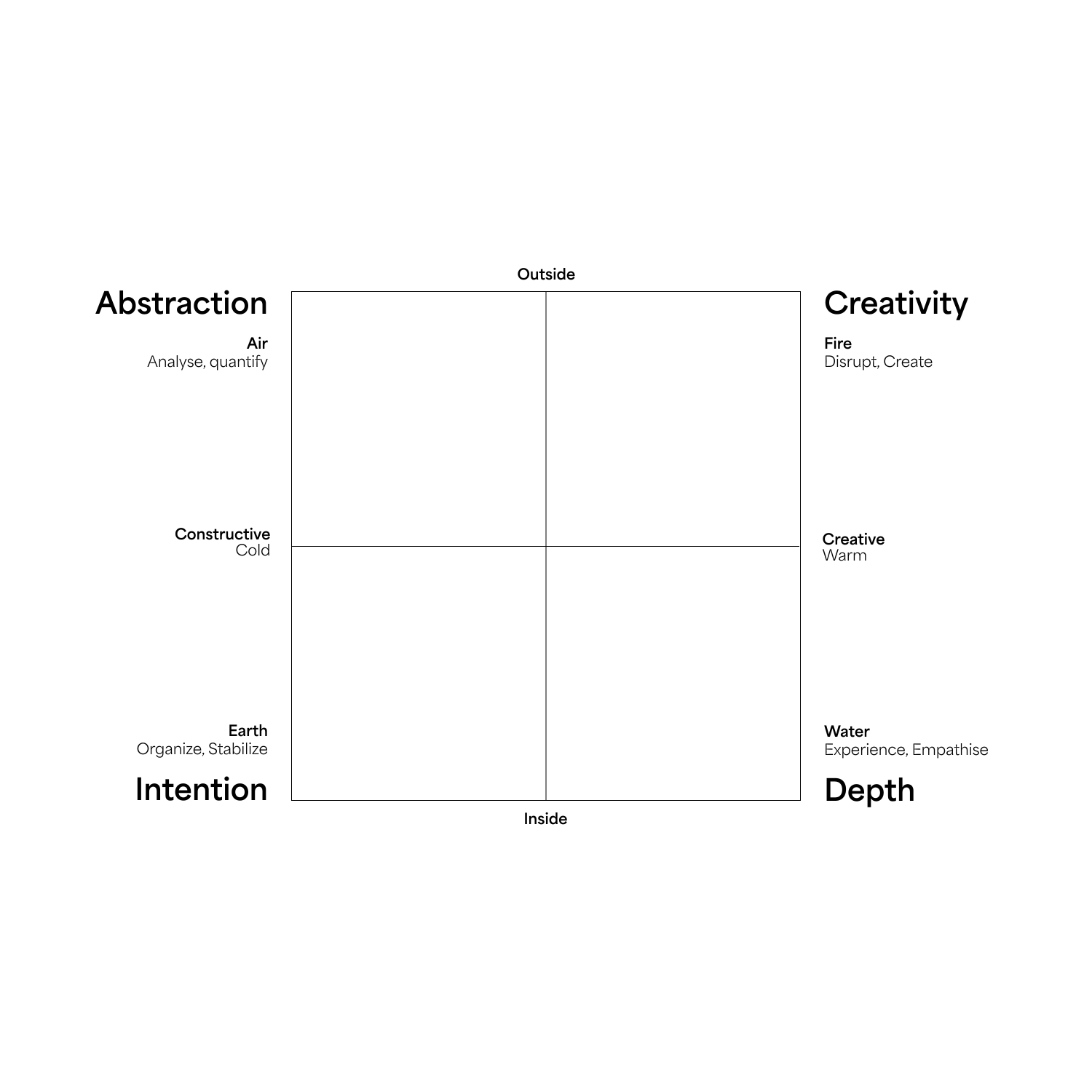
On the original framework, Abstraction sits upper left, Creativity upper right, Intention lower left, and Depth lower right. The heat shows relative emphasis in the evidence you shared. Red marks stronger inferred emphasis, fading through yellow, green, cyan, and blue.
Several areas can lead together, and different settings may bring out different patterns. A cooler area is not a personal failing. An area without enough evidence should be marked unknown. Heat does not measure ability, worth, or how confident the assistant is.
Explore the original framework or see how an illustrative heat map works.
Turn recognition into something useful
Start by asking: what feels accurate, what does not, and where do I act differently? Add examples and ask the assistant to revise the profile and map. A useful interpretation should become more specific as you contribute.
Choose two or three small experiments. You might protect time for a strength that gives you energy, try a different approach to a recurring difficulty, or ask someone you trust what they notice. Decide what you will observe and revisit the profile after trying it.
Let the profile help you make thoughtful choices about how you work and relate to people. There is no ideal balance to achieve and no fixed type you need to fit.